Wednesday, August 5, 2020

The Art of Survival Contest and Conservation at Ol Pejeta

Our boys recently entered a contest called "The Art of Survival" organized by Ol Pejeta Conservancy here in Kenya.  The tagline says it all: "A Creative Challenge for Children Who Care About Conservation."  If there's one thing true of the Horn boys, it's that they love all wildlife and care deeply about protecting and conserving that part of God's creation.  So this contest was a no-brainer!

Children ages 5-18 could enter (so poor Asa wasn't allowed to enter, although he still created a piece of artwork alongside his brothers), and they could submit anything creative like a picture or essay or craft or anything they could think of.  The only stipulation was that submissions needed to center on the theme of extinction.

Caleb settled on an essay about bongos, a very endangered mountain antelope whose natural habitat is right next door to us in the Mount Kenya National Park (and also in the Congo). The species' numbers dropped so much in recent decades that they nearly became extinct.  Conservation efforts have been successful in increasing their numbers but there's still much work to do to truly save the bongo.  One of Caleb's greatest desires is to see a bongo in the wild.  Not sure if that will ever happen since they're very shy creatures and live in the forests which obscure the chance to actually see them, but his desire remains steadfast.  Here is his essay (with spelling and punctuation corrections by me):

"Bongos are the largest antelope in the Congo.  They can weigh up to nine hundred pounds.  There are only 100 left in the wild because of hunting their meat and skins.  I'd rather see a bongo in the wild than a dead one in a museum."


Kai opted for a photo essay about orangutans, another extremely endangered species.  He drew a picture on the front and wrote an essay on the back.  It says:

"The orangutan's jungle home is being cut down and now they only live in two islands - Borneo and Sumatra - in Indonesia.  They don't even live in all of the islands because they cut down so much trees.  They cut the trees for farm land.  I don't like that.  Bye!"


And to no one's surprise, Asa drew a picture of a rhino.  He loves drawing pictures of rhinos and I love each and every one!  My 4-year old's art is one my great pleasures in life.


Asa's picture showcases his passion for rhinos, but it's also the result of memories of going to Ol Pejeta for the first time and meeting Najin and Fatu up close - the last two northern white rhinos on the planet.  We took a trip to Ol Pejeta one year ago, in August 2019, in order to meet these rhinos in person and to learn about their story and what's being done to try and save their species.  It was the experience of a lifetime.  Ol Pejeta is less than 3 hours away from us and it was one of those things we just knew we had to do since we live so close to the conservancy.  (And although I had every intention of posting photos from that day a year ago, I never got around to it and so I'm posting them now.)


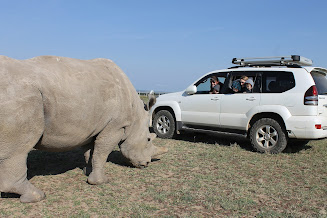
Najin and Fatu are a mother-daughter duo who live in an expansive enclosure that's guarded round-the-clock to ensure their safety from poachers.  Najin's father, named Sudan, was the last male northern white rhino who died in 2018 (of natural causes).  So it's just these two lovely ladies that remain.


Any tourist at Ol Pejeta can drive by their enclosure and see Najin and Fatu from a distance through the fence.  But we paid extra to drive directly into their enclosure and see them up close.  A ranger came in our vehicle with us and brought a carrot treat for the rhinos so they came right up to our car.  And the ranger told us all about the northern white rhino species.  We learned so much that day!


Rhinoceroses are such beautiful creatures.  Magnificent, prehistoric creatures that would live such peaceful lives if not for the constant threat of poaching.  Rhino horn is still prized as a traditional medicine product in many cultures.  Poachers kill rhinos just to cut their horns off and illegally sell them on the black market.  It's a horrible fate for any of God's creatures, but especially mind-numbing given the complete falsehood of the idea that rhino horn has medicinal value.  It does not.  Rhino horn is made out of keratin - the same as our fingernails and hair - which means their horns never stop growing (although they can be filed down by rubbing their horns against something).  There is absolutely no medicinal value in rhino horn.  Nobody needs a rhino horn except a rhino!

In order to further protect these last two northern white rhinos, rangers de-horn Najin and Fatu every couple years by literally sawing off their horns.  They take such a drastic measure to hopefully prevent poachers from being too interested in them by keeping the size of their horns to a minimum.


Poaching has led to Najin and Fatu being the last of their kind.  And sadly, neither Najin or Fatu can carry a pregnancy.  We were told one has a uteran problem and the other has sensitive feet from walking on concrete for several years at a zoo which precludes her from safely carrying the extra weight of a pregnancy.  Because of that, neither of them will ever be able to save their species by themselves.  That's why science stepped in.


Years ago, as conservationists thought ahead to the plight of this species, scientists took sperm from some males and froze it for future efforts to save the northern white rhino.  Then, last year scientists harvested eggs from both Najin and Fatu which led to the successful creation of three embryos that are currently being stored in liquid nitrogen with the plan to implant them in surrogate mothers (of the southern white rhino species) in hopes of giving the northern white rhino species a chance at survival.


We were so honored to meet these beautiful creatures and hear their story.


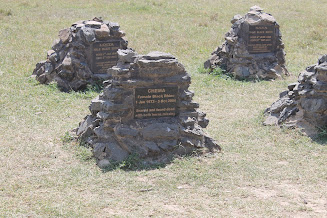
Another place that greatly impacted us was the rhino graveyard and memorial site.  Some rhinos are buried here, including Sudan, and the rest of the markers are memorials to every rhino that's been poached at Ol Pejeta.  It was a sobering thing to see, particularly because each plaque gives the name of the rhino poached, as well as when and how it was done.  It was educational for us and served to bolster our love for all of God's creatures and our desire to protect them from human hands bent on their destruction.  We spent some time praying together as we sat there.  Praying for protection for the rhinos of Ol Pejeta, and for their numbers to grow, and also gratitude that God gave us such incredible creatures to love and respect in the first place.


After that we turned to happier thoughts as we visited Baraka, the blind black rhino under the care and supervision of rangers.  Visitors can meet him and give him a snack!  Baraka (which means "blessing" in Swahili) is blind because of cataracts in one eye and because he literally lost an eye due to a battle with another rhino several years ago.  We were delighted to spend some time with him.


At the end of the day we had another amazing, once-in-a-lifetime experience.  We got to feed the chimps at the Sweetwaters Chimpanzee Sanctuary!  The sanctuary is a haven for chimps who've been rescued from the illegal pet trade.  Chimpanzees are not native to Kenya, but Ol Pejeta has become home to 36 chimps who've been rescued from several different countries.  All of these chimps suffered severely at the hands of humans but now live in peace and safety with constant care from rangers.  It's an inspiring place that reminded us that good people are doing good things to bring good out of evil around the world.  The sanctuary was created with the combined efforts of Ol Pejeta, Kenya Wildlife Service, and the Jane Goodall Institute.  Jane Goodall is one of the boys' heroes, so it felt all the more appropriate to visit a place she had a hand in establishing.

We joined the rangers as they carried the evening meal to the chimps, and the boys took turns throwing fruit into the enclosure.  The chimps were loud and very entertaining!  They ate papaya, bananas, yams, and more.


The rangers somehow kept track of which chimps had eaten what, and so directed the boys to toss fruit to certain chimps that still needed their bananas or whatnot.  It was amazing how well known the chimps are to the rangers.  We were told all their names and their personalities and how old they are, etc.  These chimps are well taken care of.


This particular chimp is named Uruhara. Jane Goodall rescued him from Burundi a couple decades ago, and she was able to visit him in 2018 when she came to Ol Pejeta.  It was surreal to meet a chimp that Jane Goodall herself rescued!


Ever since that first trip, Ol Pejeta has held a special place in our hearts.  It does a remarkable job promoting and modeling wildlife conservation, and our boys were very excited to participate in The Art of Survival Contest.  We have ongoing conversations in our house about how to cherish and take care of God's creation, how to appreciate it and respect it as God's gift to us.  Caleb and Kai currently want to be naturalists when they grow up, and I wouldn't be surprised if that actually comes to pass.  There are many reasons I'm thankful for their chance to spend these years in Kenya. Their regular exposure to wildlife and ever-increasing love for it is one of the greatest reasons.


Friday, July 24, 2020

New Discoveries: Reticulated Giraffes and a Tree Canopy Walk

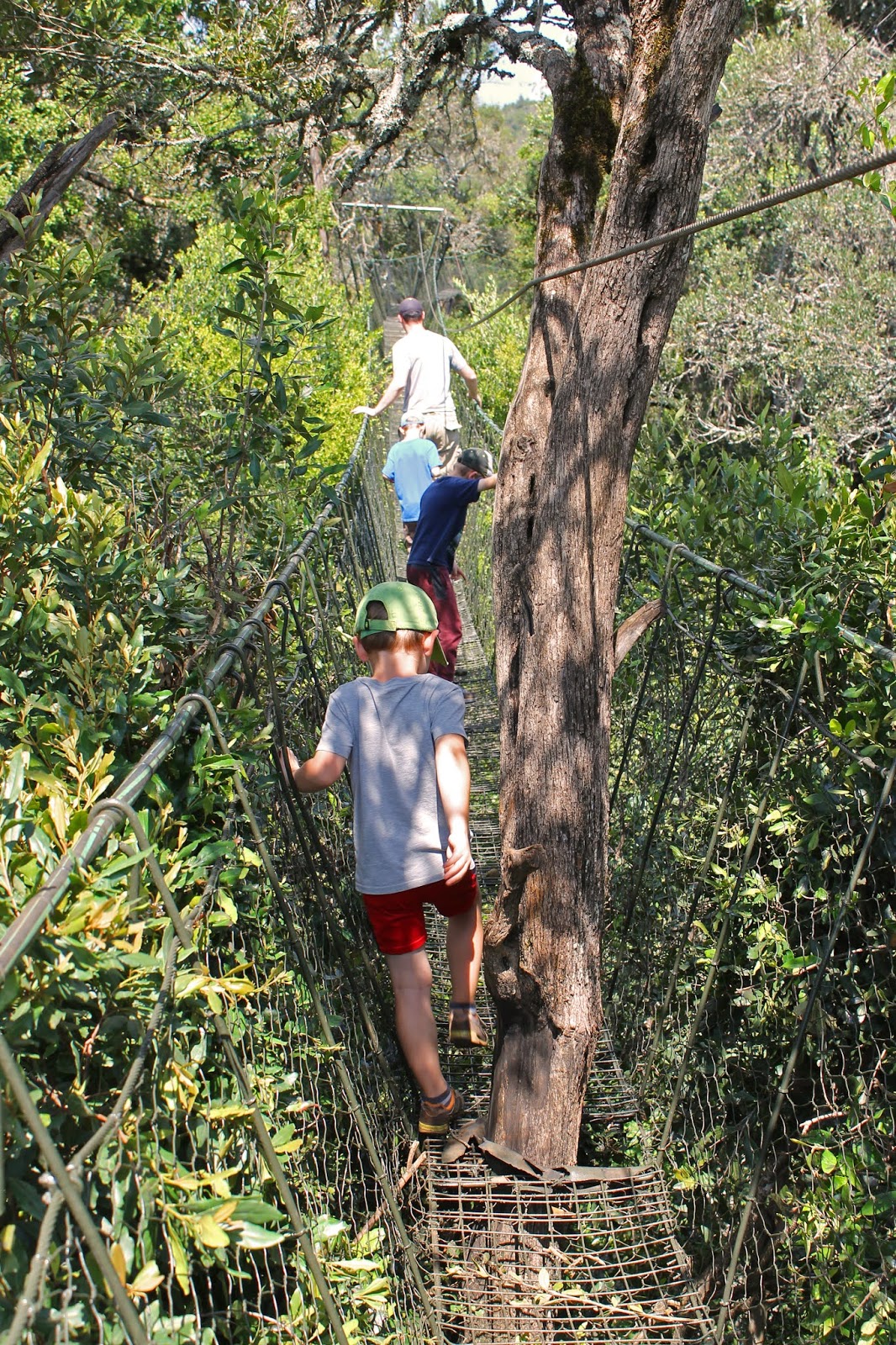
We recently discovered the Ngare Ndare Forest.  It has a Tree Canopy Walk that lets people walk 30 feet above the ground and see the forest from the air.  It's just a couple hours from us and we knew we had to check it out!

On the way there, while I was reading a book out loud to the boys and not paying attention to our surroundings, Asa suddenly shouted, "Giraffe!"  Sure enough, there was a group of 4 giraffes right by the road.  Not only that, they were reticulated giraffes, which we'd never seen in the wild!  All the giraffes we've seen in Kenya so far have been maasai giraffes, which have a different pattern on their bodies and live in a different part of the country, so this was a rather exciting find.  Reticulated giraffe numbers are in serious decline and conservationists aren't sure why, but thankfully studies are now being done to try and understand why and to hopefully stop the decline.

What beautiful creatures?  I'm so glad Asa was looking out the window and spotted them!


Soon after, we arrived at the tree canopy walk.  It was a hidden gem.  Set in a beautiful forested area, it was quiet and peaceful with nothing but the sounds of birds and the occasional baboon around us.  We could see for miles and would've seen Mt. Kenya in the distance if the clouds weren't obscuring it.  It was such a wild and lovely place.


The structure was sturdier than I expected and was easy to walk along.  The boys were comfortable managing on their own although Asa wanted to stick close to Mama the whole time.  It was one of those experiences when we realized again how much these boys are growing, in size as well as independence and confidence.  It's so fun to be at a stage of life when we can do things like this now!


The canopy walk ended at a deck with these amazing tree branches hanging down.  The boys could swing on them and loved pretending to be apes swinging in the trees.  Anything that can be climbed on will be climbed on by these three!


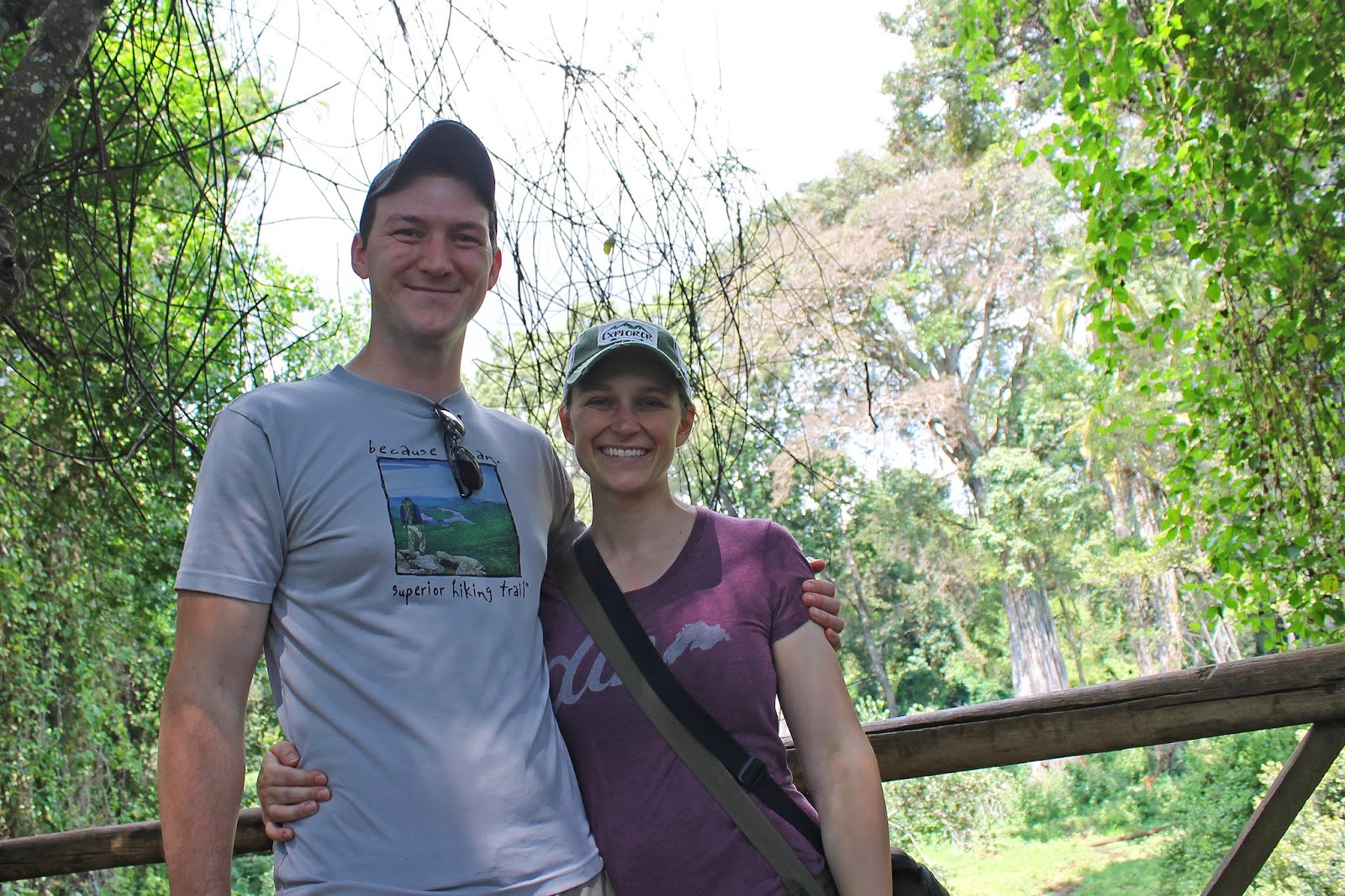
On a sidenote, I'm trying to be better at taking pictures of just me and Eli, which I rarely do anymore but which I still want for proof of us making memories together.  And I've recently discovered how relatively easy it can be to snap photos with three boys eager to use my camera!


We had the option to walk back with the ranger on the forest floor, but we couldn't resist the opportunity to walk along the canopy again as we headed back to the car.  It was just too neat to pass up.


On the way back we noticed something below that we hadn't seen before: an elephant skull!  How cool is this?  We knew that elephants live in the area and that sometimes people even see elephants at the river below, but this was such an unexpected and neat discovery.


For anyone with enough energy and stamina afterwards (which our boys did not possess), there's also a ranger-guided 3km hike to a waterfall.  Someday we'll be able to do that, but the tree canopy walk was about all we could handle for now.  We did, however, go a short way down the trail so the ranger could show us this cave.  He said that once while he was showing this spot to tourists a hyena came running out of the cave!  He also said that leopards will take shelter in there sometimes, all of which was enough to convince me to stay away from caves in Kenya for awhile.  The boys, on the other hand, were ready to camp out there with hopes of spotting whatever wildlife might visit.  Oh, the young and the brave!


It was a fun day of exploration and discovery.  I'm so thankful for an adventurous crew that's willing to go new places and try new things!


Tuesday, July 7, 2020

Poke the Hedgehog

In America we have raccoons, skunks, and foxes that roam around at night.  In Kenya we have mongooses, genets, and hedgehogs.  We hadn't seen any of these nocturnal creatures yet, but recently some friends surprised us by bringing a hedgehog to our house just as the boys were getting into bed.  They had found it right outside their house, near the shamba, busily slurping up termites.

On a sidenote, you know you have good friends when they love your kids enough to run across the compound with a hedgehog because they want to show it to these animal-loving boys before they fall asleep and miss their chance!


The boys affectionately named this cutie "Poke" which we thought was rather appropriate.  It was hard to get a picture with his face since he was completely curled up most of the time, but he once snuck his face out for a peek and I snapped a quick photo.  If you look closely, you can see termites stuck to his quills.  I'm sure they made for a yummy "take and go" snack after we let him go!


To say our boys were excited would be an understatement.  This was the highlight of the week!  This was something we could check off our list of "animals we've seen in Kenya" which we keep track of by putting stars next to entries in our books Mammals of East Africa, Snakes, Other Reptiles and Amphibians of East Africa, Birds of East Africa, and Insects of East Africa.  These boys keep very close tabs on what we've seen and where we've seen them, and there is soooo much excitement whenever there's a new find.


Caleb is in a strong "I want to go on a night safari" phase so a few weeks ago we walked around the compound at night as a family, just in case we'd see something roaming around in the dark.  No such luck.  But his hopes remain high and this hedgehog only increased his hopes of finding more nocturnal creatures.  He's determined to see a mongoose in its natural habitat, or a genet or a civet or some bats.  This boy will not be deterred.  It's that kind of determination that makes a good naturalist, which is what he wants to be when he grows up.  We think he's well on his way!


Monday, June 22, 2020

Trips to Nanyuki

Like everywhere else in the world, travel around Kenya has been limited since Covid-19 came to the country.  We've mostly stayed put in Chogoria since March, which is a great place to stay put.  Nairobi is completely off-limits since the city has been on lockdown for months, but thankfully we're still able to travel to Nanyuki on the other side of the mountain.  Nanyuki is a great town where we can stock up on groceries, including Western goods, and also enjoy the feeling of "getting away" for a night or two.  It's one of our favorite places in all of Kenya.

After nine weeks without leaving Chogoria and literally not going more than a quarter-mile radius from our compound, we went to Nanyuki for a couple nights over Mother's Day weekend.  It was good for our souls to just go somewhere, and to get some supplies.

We stayed at a wonderfully charming historic house that we discovered last year.  The house was built in Nairobi in 1912 and was slated to be torn down, but a British family decided to rescue the old house by moving it to Nanyuki.  The house was disassembled piece by piece in Nairobi, then reassembled piece by piece in Nanyuki and is used as an AirBnb site.  The wrap-around porch has a lovely view of Mt. Kenya, which I thoroughly enjoyed while eating the Mother's Day omelette Eli made for me.


That porch was the perfect reading spot.  Few things make me happier than time and space to read a good book (and a favorable ambiance, which this porch provided in spades).


While I sat reading, the boys had a blast playing in the yard and running amuck (including Daddy Horn).  It was a breath of fresh air to get away from the hospital for a bit.


Shortly thereafter we had the privilege of going to Nanyuki again, this time to Ol Pejeta!  We'd never actually stayed inside the conservancy before, but Covid discounts made it possible.  Our safari tent sat right along a pathway to a watering hole, and we saw these two black rhinos walking past as soon as we arrived.  It was only the beginning of some amazing wildlife encounters!


We followed this pair down to the watering hole, which was in front of the resort's dining hall.  They took a drink and hung out for awhile, and we got to watch them up close and personal!  The wildlife of this country never ever ever gets old to us.  We are amazed every time!


Check out the horn on this mama!  It's one of the longest and pointiest rhino horns we've ever seen.  Did you know that rhino horns, like fingernails, are made out of keratin and never stop growing?  Rhinos have to rub them to trim them down, like filing a nail.


Asa, of course, was particularly excited.  He's the most rhino-lovin' boy out there!


Also near the dining hall were these two birds.  A Verreaux's Eagle Owl was sleeping in a high branch of a tree - it was the first wild owl we've seen in Kenya and later that night we watched it hunt!  It swooped across the yard, caught something in its talons which proceeded to shriek its death knell, and then the owl landed in another tree and started eating dinner.  It was amazing!

The other bird is a Go-Away Bird, so-named because of its distinct call that sounds like it's saying "go away" and which we knew about from a picture book called The Go-Away Bird by Julia Donaldson (author of the Gruffalo books), but we'd never actually seen one yet.  On our first night at Ol Pejeta, there it was, right above our heads in a tree.  Such a fun discovery!


And this bushbuck greeted us back at our tent.  Apparently a number of them jump the electric fence each evening to avoid predators who aren't nimble enough to jump the fence themselves.  Smart antelope!


In the afternoon, Eli drove the kids around the conservancy to see animals and I hung back to sit on the porch in peace and read.  Have I mentioned how much I love time and space to read a good book?  You might be catching onto a theme here :)  The only problem is how little time and space this Mama has to actually sit and read a good book.  It's very rare.  So when the hubby offers to take all the kids away for a couple hours and leave me in peace, I've hit the jackpot.  It was a double jackpot when a literal pot of chai was delivered to our tent.  It was a triple jackpot when this behemoth walked right by!  What a tank!  What a beautiful, muddy, sour-faced tank of a creature!  Gotta love me some white rhino staring me in the face!


And then this!  We came back from supper to this!  An entire herd of elephants ambling toward the water hole at night!  Thankfully there was a spotlight near our tent so we could see them.  They were so quiet we might never have known they were there except for that one light.  It was like a dream.  Baby elephants and their mamas!  Baby elephants!!!


After all that excitement, we crashed into our beds and zonked out.  Now, something I do NOT love is getting up early.  I used to be able to do it.  I used to want to do it.  That was years ago.  Like, years and years and years ago, back in college.  Nowadays, I can hardly get out of bed in the morning.  I hate waking up and would sleep half the morning if I could.  So the fact that I did wake up early on this one particular morning at Ol Pejeta - early enough to see the sunrise - will go down in the history books of Mama Horn.  I won't deny that it was hard to do, but I am so glad I got out of bed.  My purpose wasn't even to see the sunrise - it was to get into a safari jeep and go on a morning game drive - but this sunrise was the highlight of that morning.  It was stunning and consumed the entire sky space over the plains.  (Notice the peak of Mt. Kenya on the right of the second photo.)


And here are some photos from the game drive.  Like I said before, the wildlife of this country never ever ever gets old to us.


So we had a couple successful trips to Nanyuki.  We're grateful for each opportunity to get away for a bit.  It's hard to mentally check out when you live at the same place that you work.  These little excursions are really important for us and we're thankful for each one, especially if they include mountainous views and abundant wildlife!